
Meibang Group Let resources circulate infinitely!
Guangdong Meibang Holding Group Co., Ltd. is a national high-tech enterprise with a registered capital of 50 million yuan. it is a practical enterprise specializing in the field of environmental protection for a long time, with a three-level qualification in environmental engineering.Established in 201 0, the company covers a total area of 50000 square meters and has three envIronmental engineering companies under its umbrella,

let resources circulate infinitely!
The Core Business Of Meibang Group ls The General Contracting Of Sand Fieldriver Regulation, pile Driving And Shield, mining Engineering, with Richinternational General Contractors. Up To Now, t Has Completed Nearly 100 Large-scale Turnkey Projects And CompleteEouipment Export Projects, coveringsoutheast Asia, South America, Pakistan And OtherRegions, covering industrialengineering, Water Engineering, Power Engineeringtransportation Engineeringpetrochemical Engineering And Mining Engineering, And Has Been WidelyRecognizedand Praised.
VISON
Becoming a leader in the infinite circulation of word resources
MISSON
Let the Earth's resources circulate infinitely
VALUE
Customer first.integrity-based,doing difficult but right things
ISO Standardization - Production Base
Adopting moder production factories and strictly implement-ing iOS standardized production, ensuring that every detail ofthe equipment is produced to high standards. Professionalproduction processes: laser cutting, submerged arc welding.independent paint booth,inteligent assembly, and otherproduction.

MEIBANG DYF Series High-Efficiency Belt Filter Press
Product Overview:
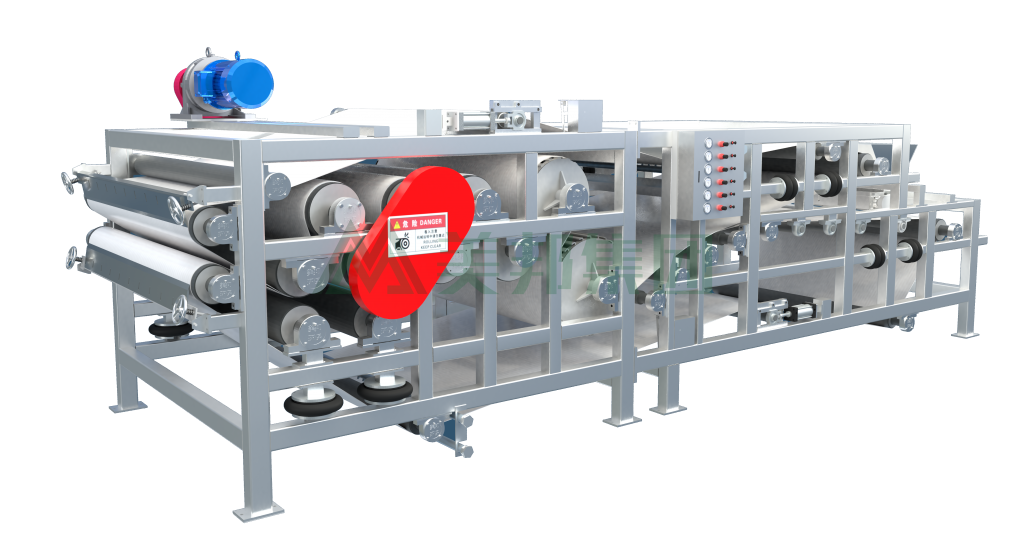
The MEIBANG DYF series belt filter press is an advanced industrial device specifically designed for solid-liquid separation. It combines the principles of chemical flocculation and mechanical extrusion. Two tensioned filter belts clamp a sludge layer, which is then passed through a series of S-shaped rollers. Shearing and extrusion forces are used to squeeze out capillary water from the sludge.
This equipment is particularly suitable for deep dewatering of sludge in municipal wastewater treatment plants, paper mills, printing and dyeing plants, chemical plants, mining plants, and food processing industries. Its filter cake has a low moisture content, and its operating costs are significantly lower than traditional centrifuges or plate and frame filter presses.
Key Features
- High-Efficiency Continuous Operation
Fully automated design allows for 24-hour unattended operation. The unique gravity dewatering zone design significantly improves processing capacity.
- Superior Dewatering Performance
Scientifically designed roller arrangement and progressive pressurization ensure no sludge leakage during pressing.
- Filter cake solids content: Up to 20% – 40% (depending on sludge properties).
- Solids recovery rate: ≥ 98%.
- Robust and Durable, Low Maintenance
- Main body material: High-strength carbon steel with anti-corrosion treatment or SUS304/316 stainless steel, resistant to acid and alkali corrosion.
- Filter belt: High-quality imported polyester filter belt from Germany/Austria, long service life, and good permeability.
- Tracking system: Equipped with a pneumatic automatic tracking device to ensure stable filter belt operation and prevent damage from misalignment. 📉 Extremely low operating costs
Compared to centrifugal dehydrators, energy consumption is reduced by 30%–50%, reagent consumption is low, and noise is extremely low (less than 75 dB).
Working Principle
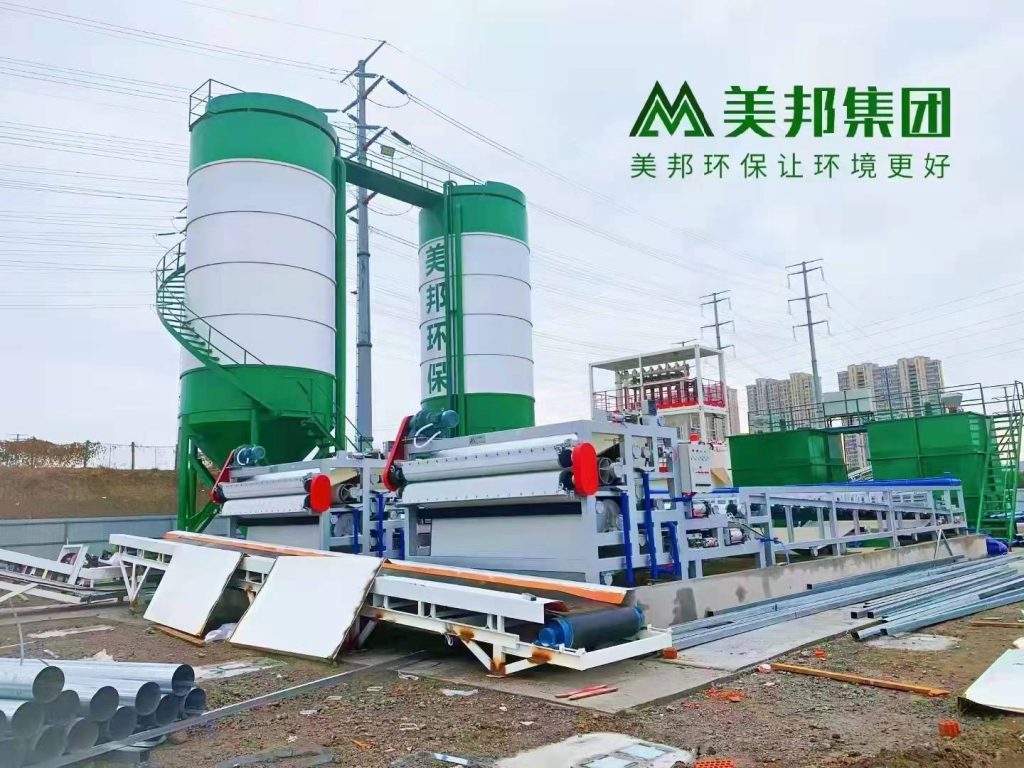
The dewatering process of a belt filter press consists of four key stages:
- Chemical Pretreatment Stage: Sludge and flocculant (PAM) are thoroughly mixed in a mixer to form large flocs.
- Gravity Zone: The flocculated sludge is evenly distributed on the filter belt, and most of the free water seeps out through the filter belt under gravity.
- Wedge Zone: The two filter belts gradually converge, forming a wedge-shaped space, applying a gentle compressive force to the sludge, causing it to further lose water and begin to solidify.
- Pressure Zone: The sludge enters the pressing zone, composed of rollers of different sizes. Utilizing the tension of the filter belt and the shearing force of the rollers, the water remaining between the sludge particles is forcibly squeezed out.